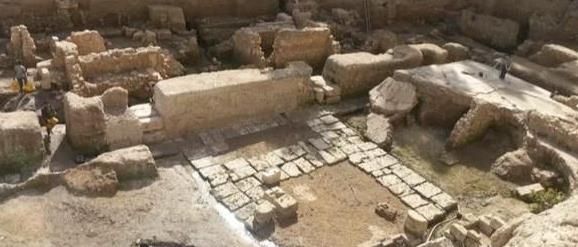
A Greek archaeological mission has uncovered the foundations of a massive limestone structure in the Royal Quarter of ancient Alexandria, a discovery that could shed new light on the urban and architectural layout of the historic district, the Ministry of Tourism and Antiquities announced on Monday.
The mission, affiliated with the Hellenic Research Institute of Alexandrian Civilization (HRIAC) and headed by Dr. Calliope Limneos-Papakosta, has been conducting excavations in Alexandria’s Shallalat Gardens area for nearly 20 years, with funding from the Moheb Kassabgui Foundation and Reliance Egypt.
According to the ministry, the excavations revealed the foundations of a large walled structure, as well as a tunnel running beneath the building northward.
Following the mission’s report, Minister of Tourism and Antiquities Sherif Fathy ordered the formation of a specialized archaeological committee, headed by Ayman Ashmawy, head of the Central Administration for Lower Egypt, Sinai and the Northern Coast Antiquities at the Supreme Council of Antiquities. The committee included senior specialists and professors of Greek and Roman history and archaeology from Alexandria and Tanta universities.
The committee inspected the excavation site and examined the architectural features uncovered before submitting its findings to Supreme Council of Antiquities Secretary-General Hisham al-Leithy, who presented the report to the minister.
The report said the site lies within the Royal Quarter of ancient Alexandria, one of the city’s most prominent historic districts. The building’s foundations and square-shaped dimensions indicate that it once supported a large, tall structure.
The discovery is also significant for research into the topography of ancient Alexandria and the extent of the massive foundations, adding to archaeological studies of the buildings that once stood in the area, the committee said.
It noted that the structure’s nature and architectural features raise the possibility that it served a funerary purpose. If confirmed, it could be the “Royal Tombs” established by Ptolemy IV Philopator (221–204 BC), according to historical sources, and mentioned by ancient Greek geographer and historian Strabo in his description of Alexandria.
Fathy described the discovery and the committee’s initial findings as significant, saying successive archaeological discoveries in Alexandria highlight the city’s unique cultural and archaeological heritage and its potential to reveal further aspects of its history and urban development.
He reaffirmed the ministry’s commitment to supporting both Egyptian and foreign archaeological missions and strengthening scientific cooperation with research institutions and specialized universities to advance archaeological studies, improve understanding of historic sites and structures and preserve Egypt’s cultural heritage.
Al-Leithy said the committee had examined the mission’s findings and the discovered architectural elements on site, adding that its preliminary conclusions confirmed the site’s importance, particularly given its location within the ancient city’s Royal Quarter.
He said the discovery opens new avenues for research into royal structures in Alexandria during the Ptolemaic period, stressing the need for further archaeological and architectural work to establish the building’s nature, function and relationship with surrounding structures.
Ashmawy said the committee had developed a preliminary hypothesis based on its inspection and study, but stressed that it remained under examination. Excavations and research are continuing to determine the building’s identity and function more precisely.
He added that the discovery represents an important contribution to the study of the structures that once occupied the Royal Quarter and their architectural and cultural functions during the Ptolemaic era. Further excavations and studies could yield additional evidence about the building and related structures.