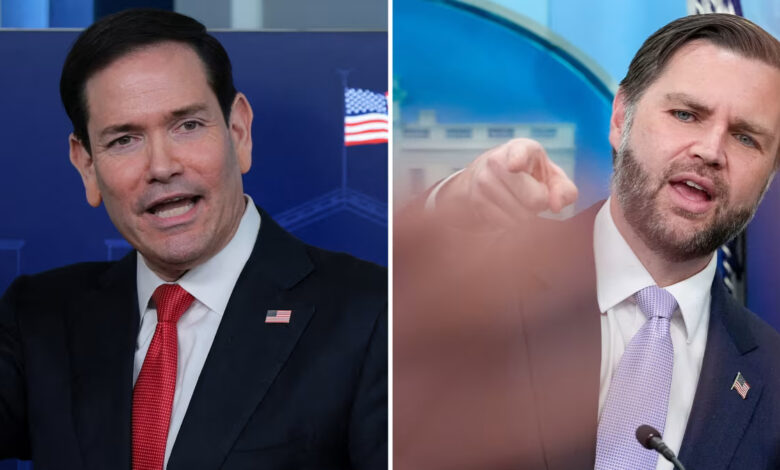
JD Vance just made his pitch in the GOP’s maternity leave primary.
The vice president held court in the White House briefing room Tuesday, with press secretary Karoline Leavitt at home with her newborn.
Vance followed Secretary of State Marco Rubio — the other half of a possible 2028 GOP presidential succession drama — who held his own briefing, which launched a viral campaign-style video on his hopes for America, two weeks ago.
The two youngish Republicans — Rubio is 54, without a gray hair in sight, and Vance is 41 — turned the clock back to a pre-Trump era of less brutish and viciously personal politics, foreshadowing how they might evolve MAGA when the president finally bulldozes his way back to Florida for good.
Given crises assailing the administration — an Iran war that it can’t end, a widening Ebola outbreak in Africa and polls showing the nation has never had less confidence in Trump — talk of 2028 seems like a Beltway fever dream.
But presidential politics never slumber. And even Trump savors dangling the prospect of a Vance-Rubio faceoff to become his heir.
Both men insist they are not running for president. That’s a no-brainer, because the incumbent is always watching.
What was more striking about this early round of “The Apprentice: 2028” is what Rubio and Vance did not do.
Leavitt’s briefings often begin with a tirade against reporters. When Trump looms over the podium, his “weave” boils with personal grievances. Neither Vance nor Rubio emulated the chest-beating of Defense Secretary Pete Hegseth. And while both were deferential to Trump, neither acted out for the boss like FBI chief Kash Patel or former Attorney General Pam Bondi in their Capitol Hill circus acts.
Both Vance and Rubio came across as serious people — a rarity in a performative administration.
Was a future president standing there?
Both men were respectful to reporters and seemed to relish issues over insults. Both were intellectually sharp, well-briefed and radiating self-confidence. Each spoke in eloquent paragraphs.
Vance, a Yale Law graduate, piled up evidence to build forensic arguments. Rubio, for his part, conjured the crescendos of rhetoric that convinced many pundits he was the next president before Trump barged into the 2016 White House race.
Close your eyes, and it would be easy to imagine either man speaking from the same spot in a few years as commander in chief.
America has been ruled by 1940s babies — Trump and Joe Biden — for nearly a decade. The spectacle of younger pretenders acting out the role underscored that a nation that often seeks out youth and promise in election years has recently looked back to an older generation to lead it.
Vance and Rubio both subtly nodded at their relative youth. Rubio refused to divulge his DJ name. Vance played the young-dad card, saying he’d ask Leavitt to step in for him when his wife Usha gives birth to their fourth child in July. And he insisted his 40-something eyes weren’t up to reading a reporter seating chart. He doth protest too much.
Both were far better spokesmen for Trump’s policies than the president himself. Vance, not for the first time, showed he understands that denying that many Americans are hurting amid an affordability crisis is bad politics. “We are very aware that because of what’s going on in the Middle East, gas prices have gone up, and a lot of Americans are struggling because of that.”
The vice president also came up with a more coherent explanation of Trump’s warnings on Iran’s nuclear program than the president has managed. If Iran got a nuke, then nations across the Gulf and elsewhere would also want one, he said. “If you have every country in the world scrambling to try to get a nuclear weapon, it would make us all much less safe.”
Vance didn’t have receipts showing claims Iran was at that threshold before the war. But if Trump had said something similar before launching his onslaught, he might not have lost the public.
Rubio painstakingly explained Trump’s “Project Freedom” — a plan to safeguard ships transiting the Strait of Hormuz. Unfortunately for him, he was standing on the trap door under every Trump appointee who makes a public statement. Within hours, the president had performed his latest TACO (Trump Always Chickens Out) and put the operation on hold.
But neither Vance nor Rubio were able to project the feral dominance with which the president fills rooms. At times, they seemed like rookies trying to corral the wild press pack that emerged alongside Trump’s insurgent politics. “I don’t know many damn outlets here, I don’t know who you all are,” said Rubio. Vance had similar thoughts. “Marco is right, this is really chaos.”
Ultimately, with their energetic yet restrained demeanors, Vance and Rubio offered a glimpse of a more conventional style of politics lost in Trump’s cacophony. They were a reminder that their boss is an aberration from generations of presidential decorum. The question for his successors will be whether that disruptive brand is a fit for the future.
What would a Rubio vs. Vance clash look like?

Rubio told Vanity Fair last year that if Vance ran in 2028, he’d be the nominee and he’d support him. So the former Florida’s potential presidential dreams might depend on a GOP defeat in two years and his own potential campaign in 2032.
Vance, meanwhile, insisted Tuesday, “I’m not a potential future candidate. I’m a vice president, and I really like my job.”
But everything can change fast in politics.
So what would a Rubio vs. Vance campaign look like?
Vance knows the MAGA base. He also showed signs he’s beginning to augment it with one of his own. He rebuked liberals who failed to condemn the assassination of his friend Charlie Kirk. He said no one should be afraid to defend their culture against immigrants when endorsing a march of far-right nationalist activists in London. And he placed US fundamental rights, including to religious freedom, in a distinctly Christian context: “You can’t force anybody to a pathway to God,” Vance said. “They have to, through their own free will, find God themselves.”
Rubio’s appearance was more confined to foreign policy — in keeping with his two simultaneous jobs as national security adviser and secretary of state. But given a political opening by a reporter’s question, he nailed it.
“My hope for America is what it’s always been,” he said, as Candidate Rubio roared out of its post-2016 hibernation. “I think it’s a hope I hope we all share. We want it to continue to be the place where anyone from anywhere can achieve anything. Where you’re not limited by the circumstances of your birth, by the color of your skin, by your ethnicity.”
Soon, his peroration appeared in full as a vertical video on his social media account. His image makers were careful to liberally splice it with videos of Trump, but the swelling music and “West Wing” vibes left no one guessing.
Rubio is a different political animal a decade into becoming MAGA compatible. But his comments offered the tantalizing possibility that he’s not fully disowned a more aspirational, positive and lyrical version of conservatism that might one day provide an antidote to scorched-earth Trumpism.
Still, Vance and Rubio cannot control their futures. For all their political skills, they are selling positions that are increasingly out of step with most Americans.
If either makes it to a presidential debate stage, they will be accused by a Democratic nominee of being complicit in what critics see as the most corrupt, incompetent and authoritarian administration in modern US history.
And in the pursuit of power, now and in the future, both contenders for Trump’s throne have made compromises that come with a side dish of hypocrisy.
In the end, given Trump’s huge unpopularity and the grave crises threatening to tank his second term, the question for Rubio and Vance may not be which of them will be Trump’s heir, but whether his political legacy is worth inheriting.