China, the world’s largest importer of energy, has so far weathered the global energy shock brought on by war in the Gulf well compared with some of its Asian neighbors.
But as global fuel markets remain volatile amid an uneasy US-Iran ceasefire and a new American military blockade that threatens Iranian exports, the stakes of the conflict are only rising for Beijing.
One reason? As the main importer of Iranian oil, China is the country that stands to be the most impacted by US moves impacting its flow – both last month when the White House removed certain US sanctions on Iranian barrels, and now, as the US military launches a blockade of Iranian ports.
These moves may not lead to immediate shortages in China, which has been well prepared for an energy shock.
But they pile more pressure on the world’s second largest economy at the same time that global fuel price hikes are beginning to ripple through it – and just as diplomats are preparing for a crucial, and already once delayed, trip by US President Donald Trump to meet Xi Jinping in Beijing, expected next month.
Xi made his most substantive comments on Middle East security since the outbreak of the conflict on Tuesday, offering “four proposals” for peace in the region, during a meeting with Abu Dhabi’s Crown Prince Sheikh Khaled bin Mohamed in Beijing.
The proposals – largely broad-based and linked to Xi’s vision to reform international security – are the latest sign of Beijing’s growing willingness to throw weight behind its calls for peace, this time after US-Iran peace talks broke down over the weekend.
The statement follows weeks of diplomacy from Chinese officials pushing for a ceasefire and promoting China as a responsible voice for peace. Trump even suggested China helped get Iran to the negotiating table in recent weeks.
How Beijing now calibrates its diplomacy in this critical ceasefire phase will be linked to how much pressure its economy is under.
“With more Chinese interests at stake, the US may be able to get China more involved in pushing Iran toward a negotiated solution,” said Yun Sun, director of the China Program at the Stimson Center think tank in Washington. “China will resort to diplomatic pressure, including bilateral and multilateral to push for the speedy lifting of the blockade.”
So, how high are the economic stakes for Beijing?

Rising costs
Most of the vast amounts of energy needed to power China’s economy and its manufacturing sector are produced domestically, and its highways are home to a rapidly growing fleet of EVs that don’t depend on gas.
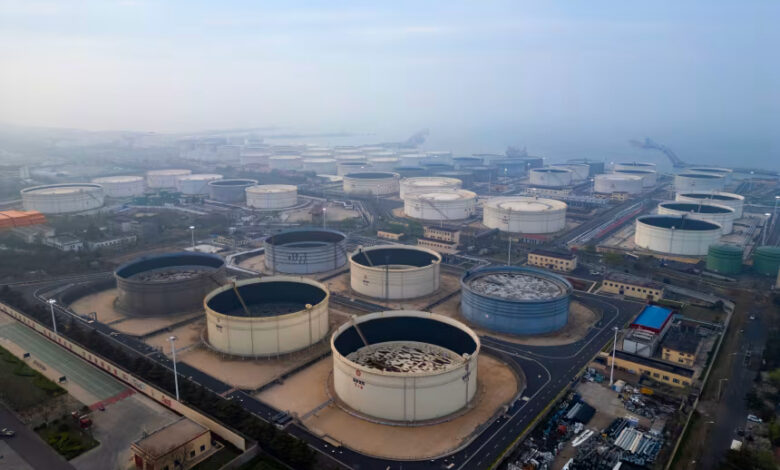
While China still relies heavily on imports for oil, which accounts for about 18 percent of its energy mix, Beijing has long worked to diversify supply. Critically, it also planned ahead, amassing enough oil reserves to last at least three months between commercial and national strategic reserves, analysts estimate, giving the Chinese economy significant breathing room.
The Chinese government has now given state refiners the green light to tap commercial oil reserves as the Iran war drags on, Bloomberg News reported on Thursday, citing people familiar with the matter.
Even still, China is not immune to the price shocks of a volatile global energy market.
China’s central economic planner has intervened multiple times to cushion the impact of global price surges on diesel and gas, but rising prices are still beginning to ripple through the economy.
Airlines have had to hike ticket fees over surging jet fuel costs. Transportation fuel costs rose 10 percent month-on-month in March, according to official economic data released last week. China’s factory-gate prices also turned positive last month for the first time in more than three years.
Those changes are ending a long deflationary cycle that was a headache for economic planners. But analysts warn that this kind of “cost-push inflation” – rather than an organic rise in price alongside a rise in demand – is not the desired fix.
“It compresses margins rather than expanding them, and squeezes household disposable income without improving consumer confidence or the propensity to spend,” Joe Peissel, a senior macroeconomic analyst at Trivium China, a consultancy, wrote in a recent note.
Meanwhile, there’s another risk: Chinese planners are well aware that the longer the war dampens the global economy, the greater the impact will be on their own export-reliant one, at a time when domestic demand lags.
The blockade effect
Some 38 percent of the oil and 23 percent of the liquified natural gas that typically passes through the Hormuz Strait is bound for Chinese ports, according to financial firm Nomura. Overall, that accounts for about half of China’s seaborne oil supply and a sixth of its natural gas.
While Iran’s control over the strait choked off much of that supply from other countries, Iranian oil – which typically makes up 13 percent of China’s seaborne imports – had continued to flow at largely normal levels.
The US blockade is expected to stymie the amount of fuel shipping out of Iran, but analysts say the impact on China may still be blunted for a few reasons.
One is that even as shipping from Iran is expected to slow, a hefty amount of reserves are already in storage or tankers offshore – and available for access.
“Iranian crude on water remains plentiful, and days of cover for Chinese refiners is hovering (at) around 120,” according to Johannes Rauball, a senior crude analyst at Kpler, noting this is if China keeps imports at normal levels. That means “a potential decline in Iranian exports will not impact availability in the near term.”
Meanwhile, a decision by the US last month to remove sanctions on certain barrels of Iranian crude sent prices soaring. As a result, the small, so-called teapot refiners in coastal China that typically process this product on narrow profit margins had already reduced their purchases, according to Tianyue Hu, an analyst at Rystad Energy.
Even still, while the blockade is unlikely to have an immediate impact on China’s energy supply, that could change if the situation drags on.
If prices continue to rise and inventories are drawn down, those refiners could reduce how much gasoline and diesel they are producing.
“Given Beijing’s priority of maintaining stable domestic supply, authorities would likely respond with policy support, such as securing alternative crude supplies or incentivizing refinery runs—to mitigate the impact,” Hu said.
How significant these impacts are depend too on whether other countries’ goods continue to be restricted in the Strait or not.

$6.5 billion at risk?
Past energy, China also has a significant economic footprint in the broader region, underscoring other stakes for Beijing in seeing the conflict resolved.
Chinese-financed infrastructure that have been targeted or are deemed at risk of being targeted in the region total some $6.5 billion, according to a recent analysis by AidData, a research lab at William & Mary University in Virginia.
Those facilities include ports, power and desalination plants, refineries and petrochemical operations, and airport infrastructure across Qatar, Oman, the UAE, Saudi Arabia, Iran, and Israel – showing the extent of China’s financial exposure. Some figures reflect AidData-estimated lender shares in syndicated loans, rather than exact financing exposure, the analysts noted.
Customs statistics show that in March, China’s trade with the Middle East turned from year-on-year growth in the first two months of the year to a decline, officials said Tuesday.
Beijing has been balancing these interests in its diplomatic rhetoric: backing Iran and opposing the US and Israeli attacks on it, while also calling for the security of Gulf states – which have become Iranian targets – to be respected.
Chinese diplomats have repeatedly called for peace in the region over the past six weeks. And while they’ve neither confirmed nor denied having a hand in brokering a two-week ceasefire agreed last week, the White House said that high-level talks took place between the US and China as negotiations around the deal played out.
The White House is closely watching any support from Beijing to Tehran, and has threatened 50 percent tariffs on any country supplying Iran with weapons. CNN reported last week, citing sources, that US intelligence indicates that China is preparing to deliver new air defense systems to Iran. China has flatly denied this.
Beijing may have an interest in seeing the US tied up in another region and not focused on competition with China. But Chinese officials have signaled they don’t want the war to impact the current stability in US-China ties, especially ahead of Trump’s expected trip to China next month.
And when it comes to taking a role in mediating, “China definitely wants to play up its goodwill gesture with US to appear to be helping,” according to Stimson Center’s Sun.
In the wake of failed US-Iran peace talks over the weekend, China’s top diplomat Wang Yi spoke on Monday with his counterpart Ishaq Dar of Pakistan, where the peace talks were hosted, stressing that Beijing is willing to continue to work with Islamabad toward peace.
Now, as the economic fallout continues to grow for China, that call may feel more urgent.