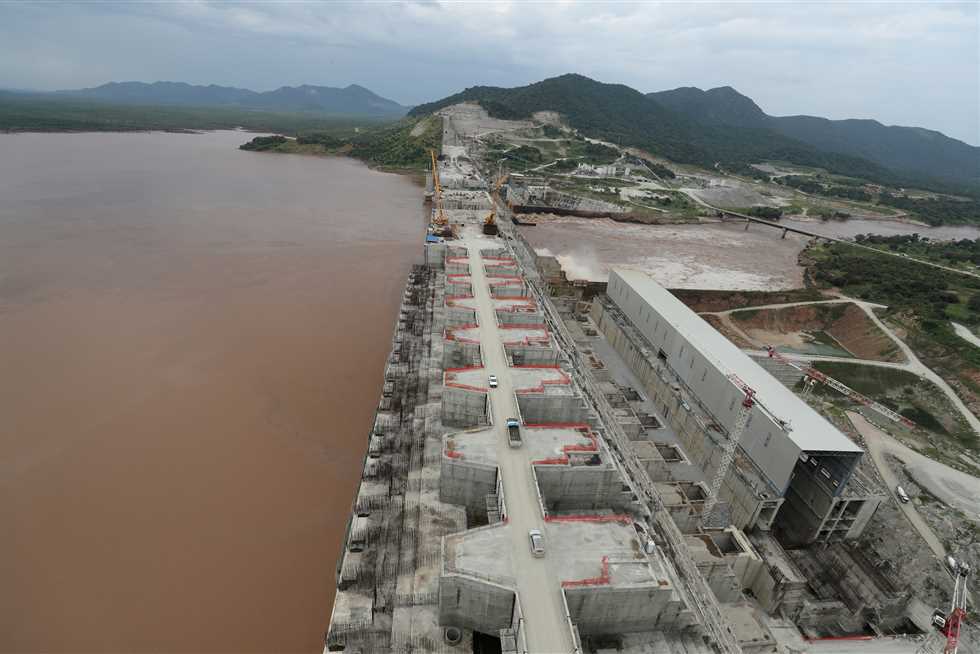
Professor of Geology and Water Resources at Cairo University Abbas Sharaki announced Monday that the turbines of the Grand Ethiopian Renaissance Dam (GERD) are not functioning properly, citing the dam’s reservoir level remaining stable at 629 meters above sea level as evidence.
Sharaki added on his Facebook page that the Ethiopia’s refusal to acknowledge this situation is leading to improper operation of the dam, specifically the failure to open one of the upper spillway gates for a gradual release of water, thus concealing the turbine malfunctions from the Ethiopian public.
He added that the result would be another flood, threatening up to 20 million Sudanese citizens living along the banks of the Blue Nile.
Sharaki pointed out that the Ethiopian people have yet to receive energy from the GERD, even though the celebration of the first turbine’s commissioning took place in February 2022 – over four years ago.
He noted that the second turbine installed in August 2022, the third and fourth in August 2024, and the remaining at September 9, 2025, according to the celebrations.
Sharaki said that some Ethiopians doubt these figures, as the truth is shocking.
Agreement must be reached
Regardless of the operational status, the professor stressed that the most important thing is reaching an agreement and exchanging information to safeguard the lives of the Sudanese people and the joint interests of Egypt, Sudan and Ethiopia.
Sharaki pointed out that the total storage in the dam’s reservoir was 47 billion cubic meters as of May 3, with the water inflow rate increasing to 22 million cubic meters per day in May.
He added that satellite images of the reservoir’s size taken on September 15, 2025, six days after the official opening, show water flowing over the top of the central spillway and also through three discharge gates on the western left bank.
The water level temporarily rose by one meter above the maximum level, he said, reaching 641 meters with a storage capacity of 66 billion cubic meters.
This level then dropped by approximately 11 meters from the maximum of 640 meters on May 3, reaching 629 meters with a total storage capacity of 47 billion cubic meters.
He said that if the turbines had been operating efficiently, the lake’s volume would have decreased to one-third of its current size by this time, coinciding with the start of the new year’s rainy season.
Edited translation from Al-Masry Al-Youm