President Donald Trump continues to claim that the US will attack Iran’s Pickaxe Mountain – turning attention to the suspected underground nuclear site where Israel believes Tehran has stored part of its enriched uranium stockpile and advanced enrichment centrifuges.
“We’ll be hitting that area very probably pretty soon. And there’s not a thing they can do about it,” Trump said on Tuesday.
In response, Tehran warned that that any US attack on Iranian nuclear facilities would be treated as an expansion of the war in the region, state media reported early Wednesday.
Here’s what we know about Pickaxe Mountain.
What is it?
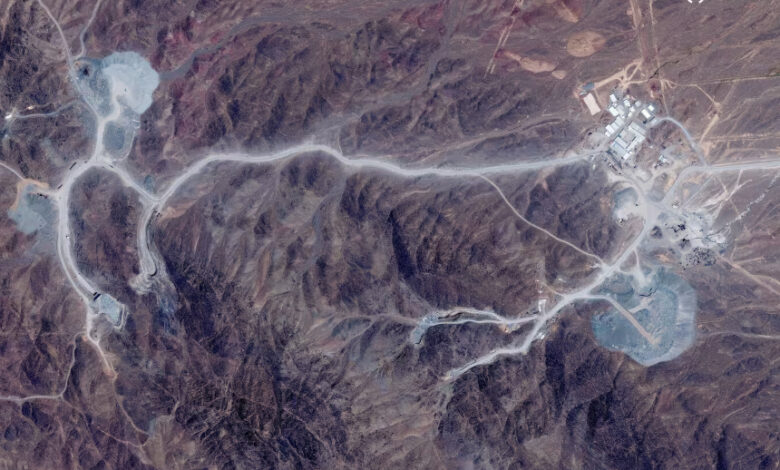
Pickaxe Mountain is a heavily fortified facility located deep underground in the center of the country, about a mile south of the Natanz uranium-enrichment facility previously bombed by the US and Israel – making it a difficult target for the US and Israel, and for any potential ground operation.
The facility is buried at least 100 meters (328 feet) under a large mountain called Kuh-e Kolang Gaz La, with Kolang translating to Pickaxe, according to the Institute for Science and International Security (ISIS).
Construction on the facility began in 2020; at the time, Iran declared the facility to the UN’s International Atomic Energy Agency as a future facility to assemble the centrifuges that make nuclear fuel.
The facility is largely shrouded in mystery; there are no publicly available schematics, and experts largely glean their insights by analyzing satellite imagery. Through these images, ISIS said in a recent report, we know the facility has several tunnel complexes, a large security perimeter, and entrances that have been hardened by concrete for protection from potential airstrikes.
The facility is believed to not yet be operational, with construction ongoing. Those efforts may have intensified in the past year, with construction increasing after Israel and the US targeted Iran’s other nuclear facilities in June 2025. Among the facilities struck was the Natanz uranium enrichment complex, just a few miles from Pickaxe Mountain.
There are several possible reasons for this increased activity at the Pickaxe site, said the Center for Strategic & International Studies. Iran could be building centrifuges, as it told the UN it would; it could be expanding its mission, bringing over operations from the other destroyed facilities; or it could be creating a secret facility to enrich uranium, a key component to make nuclear weapons.
Is there enriched uranium there?

Israeli intelligence believes Iran moved part of its enriched uranium stockpile and advanced enrichment centrifuges to Pickaxe Mountain after last June’s attacks, an Israeli source familiar with the matter told CNN.
During that 12-day war, Israel struck three key Iranian nuclear facilities – Natanz, Isfahan and Fordow – and killed a number of top scientists involved in nuclear research and development. The US joined the fight near the end of the war, striking the same three facilities with much more powerful bombs, attacks in which Trump claimed Iran’s nuclear capabilities had been “obliterated.” But neither the US, nor Israel struck Pickaxe Mountain.
US and UN intelligence later suggested that parts of Iran’s nuclear program remain intact, albeit damaged. And it since become a shared goal of both the US and Israel to either make Iran dispose of its nearly 1,000-pound stockpile of highly enriched uranium, or to take it from them.
CNN previously reported that Iran had dramatically escalated efforts to seal off its cache of near bomb-grade uranium, deliberately collapsing tunnels and booby-trapping entrances with explosive mines.
When asked on Tuesday whether Iran had moved its advanced centrifuges to Pickaxe Mountain, Trump seemingly downplayed the Israeli reports, saying: “We don’t have it on record.”
Earlier in July, a senior security source in Tehran told CNN that the claims of nuclear activities taking place at Pickaxe Mountain were false.
Iran maintains that its nuclear program is solely for peaceful energy purposes, and plans to build additional nuclear power plants to meet domestic energy needs and free up more oil for export.
Could it be attacked by the US and Israel?
Analysts have mixed opinions.
One nonproliferation expert, Andrea Stricker, told CNN that Trump should act to disable Pickaxe Mountain to prevent Iran from “reconstituting an enrichment or nuclear weapons option, and having access to thousands of centrifuges that represent the remnants of its nuclear program.”
While a ground operation would be complex, the ISIS report pointed out several possible avenues for attack.
The secretive facility would need ventilation, heating, cooling, deliveries, power supply, and personnel – which all present “vulnerabilities that the U.S. and Israel would seem to be able to exploit,” it said.
Strikes, though, may not have the desired impact because the core part of the facility is likely deeply buried.
James Acton, who co-leads the Carnegie Endowment’s nuclear policy work, posted on X that he doubts the US can do much more than collapse access tunnels at the Pickaxe Mountain facility. “That isn’t a game changer,” Acton said.
CNN’s Davis Winkie, Tal Shalev, Mohammed Tawfeeq and Catherine Nicholls contributed to this report.