The call that US President Donald Trump predicted didn’t happen, but he left little doubt about what would come next.
On Thursday morning, Trump said Israeli Prime Minister Benjamin Netanyahu would speak to Lebanese President Joseph Aoun. It would have been the first direct contact in decades between the leaders of the two neighboring countries, which have no diplomatic relations. Trump declared that it would provide for “a little breathing room.”
But against the backdrop of a hot war between Israel and Iranian proxy Hezbollah, Aoun declined the call.
Trump wasn’t waiting for a conversation to happen.
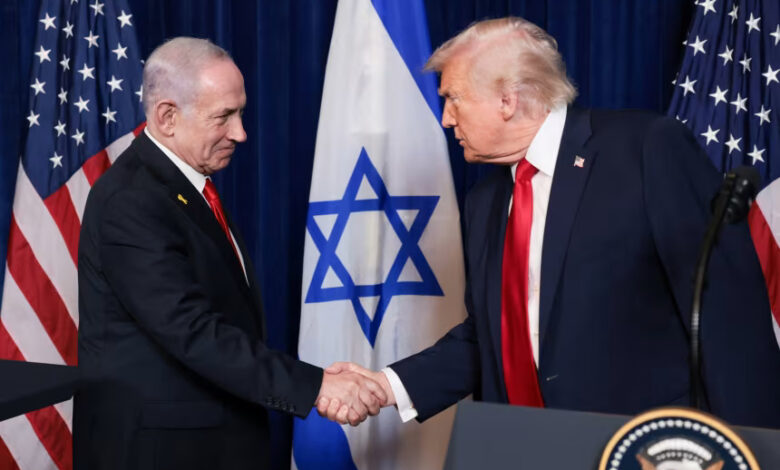
Just hours later, Trump announced that a ceasefire would begin at midnight. And Netanyahu had little choice but to go along. It is the latest example of a pattern whereby Trump’s declarations box in perhaps his most vocal international supporter, compelling Netanyahu to make critical strategic decisions based on what the US president will allow. Netanyahu routinely hails the close coordination between the US and Israel – between himself and Trump – but at key moments, Trump has forced his Netanyahu’s hand.
Less than a week ago, Netanyahu had vowed that the war against Hezbollah was still going. “We are still fighting them,” he said. “It is not over yet.” And on Wednesday, Israel Defense Forces (IDF) Chief of Staff Lt. Gen. Eyal Zamir said that he had just approved more war plans in Lebanon and Iran.
But without Trump’s approval, Netanyahu has little room to maneuver. Although the temporary ceasefire is supposed to last 10 days, it’s clear Trump intends for it to hold. “It has been my Honor to solve 9 Wars across the World, and this will be my 10th,” he boasted on social media.
In a security-cabinet meeting on Wednesday evening, Israeli leaders discussed the possibility of a temporary ceasefire. But there was no vote and no admission that an end to the war may be just days away. On Thursday evening, moments before Trump announced a ceasefire in Lebanon, Netanyahu convened his security cabinet again for a remote consultation.
Israelis – politicians and residents alike – learned about the ceasefire not from Netanyahu but from a Trump social media post.
“At this stage of the war, which he entered into largely due to Netanyahu’s persuasion, Trump has become the final, if not the exclusive, arbiter,” wrote Amos Harel, Haaretz’s military analyst. “Just as Trump forced the conclusion of the previous 12-day war against Iran in June, he has now imposed temporary ceasefires in Iran and in Lebanon.”
Forcing Netanyahu’s hand – over and over
In total, Trump has forced Netanyahu’s hand on at least five separate occasions, including the two wars with Iran. The US president pressured Netanyahu into a ceasefire with Hamas in Gaza, and he compelled Netanyahu to call Qatar and apologize for a failed Israeli strike in Doha targeting Hamas leaders. Lebanon is just the latest example.
And in each case, Israel fell short of the decisive victory it desired … and which Netanyahu had promised. In Gaza, Hamas has firm control over the half of the coastal territory not occupied by Israel. In Lebanon, Hezbollah remains a formidable threat capable of launching drones and rockets at Israel. In Iran, the regime of Supreme Leader Ayatollah Ali Khamenei is now the regime of his son, Supreme Leader Mojtaba Khamenei.
The Israeli military has expanded its territorial grip on each front, holding more land in Gaza, Lebanon and Syria. And, at least as of now, there has been no real pressure from the White House for Israeli forces to withdraw. For Netanyahu, these swaths of land are deeper security zones, which Israel may well hold for years. But they are far from victory.
Israel’s adversaries have no doubt been weakened, but they have survived.
Danny Citrinowicz, an Iran expert at Israel’s Institute for National Security Studies, said Tehran will enter the next round of negotiations from a position of strength. “Given its demonstrated willingness, and capability, to impose significant costs on its neighbors and on the global economy, Tehran is unlikely to concede under pressure alone, regardless of escalating threats from Washington,” Citrinowicz said on social media.
On Friday, Netanyahu said in a statement that he had agreed to the temporary ceasefire “at the request of my friend, President Trump.” But he warned that Israel was ready to resume the war. “One hand of ours holds a weapon; our other hand is extended in peace.”
Trump would have none of it. Twenty minutes later, he said – once again on social media – that “Israel will not be bombing Lebanon any longer. They are PROHIBITED from doing so by the U.S.A. Enough is enough!!!