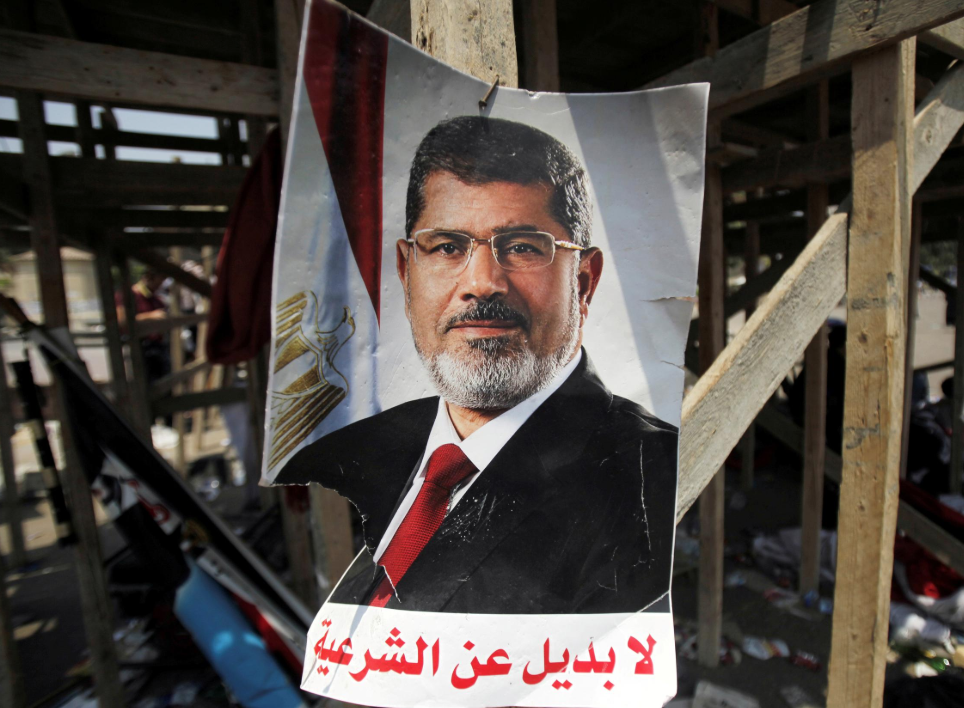
As President Mohamed Morsy wagged his finger at Egyptians in his televised address to the nation on 27 January, my mind wandered back to the televised addresses former President Hosni Mubarak gave during his last 18 days in power.
Back then, too, there were pitched battles in the streets of Cairo, Suez and Port Said. Back then, too, the police sought to bludgeon Egyptians into submission as the government invoked the Emergency Law and granted the military arrest powers.
And back then, too, there appeared before the nation a president who sought to accuse rather than convince — whose paternalistic attitude toward Egyptians was matched only by his apparent disconnect from reality on the ground.
Of course, there are those who are celebrating the downfall of the Brotherhood — who are relishing the irony of the organization, resorting to the very legal instruments that were used to repress it. Nevertheless, I cannot escape a certain sense of tragedy as I observe how precipitously the president and his allies have fallen since their rise to power a mere seven months ago.
This is not to say, of course, that the president can shirk his responsibility for the morass in which Egypt currently finds itself. Had he adopted a different path — the path of magnanimity and collaboration that he promised when he took his symbolic oath of office in Tahrir Square — the situation would be altogether different. There would not exist the ever-widening chasm between the Islamists and their opponents that now characterizes the Egyptian political scene.
And there would exist a constituency of Egyptians willing to give the nation’s first civilian president the benefit of the doubt.
That constituency, which once numbered in the millions and included countless non-Islamists, has dwindled. The Freedom and Justice Party would have Egyptians believe that remnants of the old regime — the “feloul” — remain behind all of the country’s problems, and are bound and determined to sabotage whatever movement toward reform the president undertakes.
But this is, to my mind, Morsy’s Achilles’ heel: a tragic delusion that will rob Morsy and the Brotherhood of whatever political success they have achieved in post-revolutionary Egypt.
Egyptian politics is not a zero-sum game. Yet that is precisely the attitude Morsy has adopted in running the country, an attitude tinged by an almost paranoid fear of losing power. Where is the confidence the president displayed when he presented himself to the masses at Tahrir seven months ago?
One cannot but wonder whether the president, who resorts to Twitter in the wee hours of the morning to speak to Egyptians on the second anniversary of their revolution, is indeed the same man who refused a bulletproof vest when he spoke to Tahrir.
There is no question that the weight of expectation that Morsy faced on his rise to power was tremendous. But so too was the moral and, indeed, revolutionary legitimacy behind the president.
After all, he had emerged the victor from the first remotely democratic presidential elections in the country’s history. With such a victory, and certainly after successfully marginalizing the Supreme Council of the Armed Forces, what would it have cost the president to reach out to his political opponents? What threat to his rule would a government of national unity posed?
Of course, that time of possibility is now in the distant past. Like the boy who cried wolf, Morsy now appeals for “dialogue” at every turn, apparently hoping that Egyptians will forget his intransigence in the constitutional debate, his reliance on a government seen as hopelessly incompetent, and his repeated efforts to clamp down on the media and circumvent the legal system.
That this is a time of tragedy for Egypt, there is, of course, no doubt. The nation mourns as lives are lost day in and day out — whether at the hands of the unreformed police, or as a consequence of an almost systematic neglect of state infrastructure.
But this is a tragedy, too, for the Brethren. Having spent over 80 years in the political wilderness, victims of violent repression for most of their existence, and finally entrusted with the power that had so long eluded them, the Muslim Brothers has wasted every modicum of good will they had before them. And now, I’m afraid, they’re finished.
Paul Sedra is an associate professor of history at Simon Fraser University in British Columbia, Canada.
This piece was originally published in Egypt Independent’s weekly print edition.