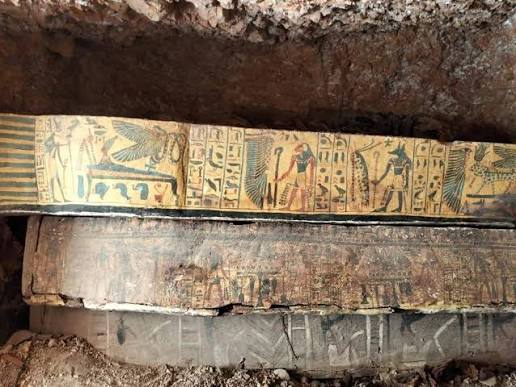
A joint Egyptian archaeological mission between the Supreme Council of Antiquities and Zahi Hawass Foundation for Antiquities and Heritage has unearthed a cache of painted coffins containing mummies, alongside a collection of rare papyri dating back to the Third Intermediate Period.
The discovery was made during excavations in the southwestern corner of the courtyard of the tomb of Seneb in Qurna area on Luxor’s West Bank.
Minister of Tourism and Antiquities, Sherif Fathy, stated that this discovery represents a significant addition to Egypt’s record of distinguished archaeological finds.
The find also reflects the full and continuous support provided by the state to archaeological research, he said, coming as result of a comprehensive strategy to preserve cultural heritage and highlight its civilizational and human value.
Former Antiquities Minister and head of the mission, Zahi Hawass, hailed the discovery as exceptional.
He explained that it reveals new secrets from the Third Intermediate Period (Dynasties 21-25), offering a wealth of information about the mysteries of this era.
He added that the excavations revealed a rectangular chamber carved into the rock, intended as a funerary burial chamber.
Inside, 22 painted wooden coffins were found stacked in several layers, reflecting a remarkable level of organization.
Hawass noted that the ancient Egyptians utilized the space efficiently by arranging the coffins in 10 horizontal rows, separating the lids from the boxes to maximize the chamber’s capacity.
The mission also unearthed a collection of pottery vessels, believed to have been used to store remnants of mummification materials.
Owners remain a mystery
The Secretary-General of the Supreme Council of Antiquities, Hisham al-Leithy, said that the mission is currently working to solve the mystery of this cache and identify its owners, especially since most of these coffins bear professional titles rather than names.
He explained that the most common title is “Singer of Amun,” which opens new avenues for studying the class of chanters and singers during that era.
Leithy added that, given the poor condition of the wood, the mission’s restoration team intervened to carry out urgent conservation work.
The mission’s supervisor, Afifi Rahim, said that the eight papyri found inside a large pottery vessel, some still bearing their original clay seals, vary in size.
He emphasized that these papyri are a treasure trove of information, the results of which the world will eagerly await upon completion of the restoration and translation work.