
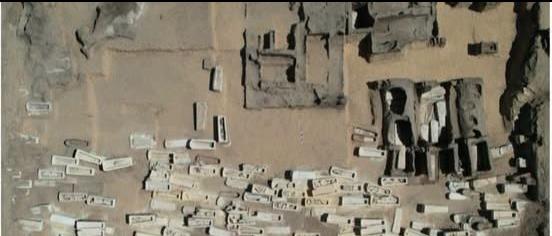
An Egyptian archaeological mission affiliated with the Supreme Council of Antiquities (SCA) has uncovered an ancient necropolis at Tell Kom Abu Billo in Menoufia Governorate, featuring tombs and burials dating to the end of the Late Period, the Ptolemaic era, and the early Roman period.
The site contains hundreds of stone and pottery coffins some anthropoid and others bearing caricatured human features alongside wooden coffin remnants, vaulted mud brick tombs, and a limestone-lined tomb.
Preliminary studies indicate the open-courtyard necropolis likely served the middle class during the 3rd and 2nd centuries BCE, reflecting funerary traditions linked to deities such as Osiris, Isis, Hathor, and Renenutet.
Minister of Tourism and Antiquities Sherif Fathy emphasized the discovery’s importance in illustrating the evolution of ancient Egyptian burial practices.
SCA Secretary-General Hisham el Leithy noted the unprecedented scale of burials at the site, which lies within the ancient city of Terenuthis (modern Tarrana) near Wadi El Natrun—historically known for supplying natron salt for mummification.
Despite past looting and quarrying damage, excavations revealed human remains with traces of mummification resins and painted cartonnage.
Recovered artifacts include gold tongues, gold jewelry and foil, inscribed faience ushabti figurines, offering tables, schist and lapis lazuli scarabs, Wedjat eyes, amulets, small sphinx and Horus statues, terracotta figurines of Isis-Aphrodite, and two falcon burials.
Excavations and scientific documentation are ongoing to further uncover the history of the necropolis and ancient Terenuthis.


