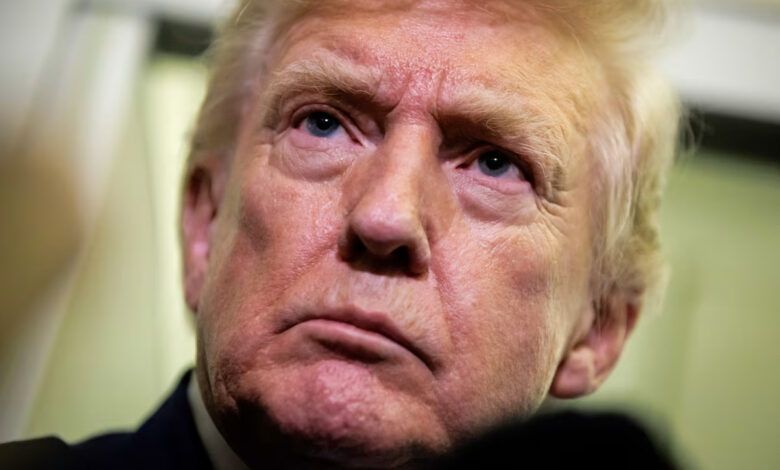
A newly discovered document in the Jeffrey Epstein files undermines one of President Donald Trump’s central claims about the matter — specifically, his supposed lack of knowledge of Epstein’s misconduct.
And it’s hardly alone.
The release of millions of pages of documents a week and a half ago has repeatedly tested and sometimes contradicted the Trump administration’s claims about what’s contained in the files, which it initially promised to release but then suddenly pulled back on before Congress forced its hand.
Administration officials including Trump and Attorney General Pam Bondi have previously made multiple claims about the files that have later been undercut. But with the release of millions of documents last month, it appears the number is now growing.
Let’s recap.
Trump’s claim to having had ‘no idea’ about Epstein and girls
When Trump acknowledged last year that Epstein accomplice Ghislaine Maxwell had recruited prominent Epstein victim Virginia Giuffre from Mar-a-Lago, he claimed he hadn’t known what for.
“No, I don’t know really why,” Trump said in July.
Trump was even firmer back in 2019, when he was asked if he had any suspicions that Epstein was molesting underage girls.
“No, I had no idea,” he said, repeating: “I had no idea.”
But plenty of other evidence has called those claims into question. And now we have the firmest suggestion yet that Trump at the very least had suspicions.
A newly discovered document describes Trump telling police in the mid-2000s, shortly after the investigation into Epstein became public, that he was glad they were “stopping him” because “everyone has known he’s been doing this.” (The document was first reported by the Miami Herald.)
The document comes from a 2019 FBI interview with a Palm Beach, Florida, police chief, who recounted a conversation he had with Trump around 2006.
Trump, in that conversation, also cited an occasion when he was around Epstein and some teenagers and said he “got the hell out of there,” according to the document.
The document also says Trump was one of the “very first people” to call the Palm Beach Police Department when he found out it had been investigating Epstein.
Asked about the matter Tuesday, White House press secretary Karoline Leavitt said she couldn’t confirm whether the 2006 phone call took place. But she said that if it did, it backed up Trump’s previous comments that he’d cut ties with Epstein in the early 2000s and viewed him as a “creep.”
The White House, however, hadn’t previously explained why Trump used that word for Epstein. And when Trump was asked about it in July, he lashed out at the reporter who asked the question.
The alleged co-conspirators
Lawmakers got their first glimpse of un-redacted files on Monday, after which some claimed that multiple men are being protected by the redactions — including alleged co-conspirators.
GOP Rep. Thomas Massie, after viewing the files, told CNN’s Kaitlan Collins on Monday that the new documents raised questions about whether FBI Director Kash Patel gave false testimony when he said in September that said there was “no credible information” that Epstein had trafficked young women to anybody but himself.
“None,” Patel said at the time. “If there were, I would bring the case yesterday that he trafficked to other individuals.”
At a House hearing the same week, Patel denied there was anything in the files that pointed to other people having engaged in underage sex.
“That’s correct,” Patel said. “To my knowledge, no.”
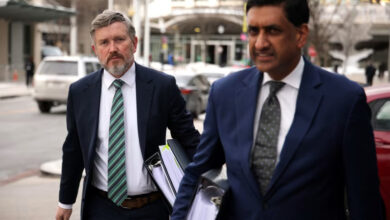
But Massie and Democratic Rep. Ro Khanna of California said after reviewing the unredacted files that they contained at least six names of people that were redacted who were “likely incriminated.”
A hugely important caveat: a name appearing in the files is not evidence of wrongdoing, and it’s not clear what the six who Massie and Khanna mentioned are even suspected of.
One of the men they cited was listed on an internal FBI document as suspected “co-conspirators,” but that document does not provide any evidence of impropriety.
The Justice Department later removed the redactions for several names. CNN has reached out to the men whose names have been unredacted.
Not redacting men’s names
But that new un-redacting also contradicts how the administration initially billed the redaction effort.
When CNN brought some questionable redactions to the administration’s attention last week, a DOJ official suggested many of them were women who could be described as both “victims” and “participants” — and that none were men.
“In many instances, as it has been well documented publicly, those who were originally victims became participants and co-conspirators,” the official said. “We did not redact any names of men, only female victims.”
The officials also said FBI and law enforcement officials were being redacted.
But thanks to pressure from lawmakers who saw the unredacted files and the names we can now see, we can now say that the redactions included the names of some men (who weren’t law enforcement).
Patel’s claim about how many times Trump’s name appeared
In the September House hearing, Patel testified that Trump’s name appeared in the Epstein files fewer than 100 times.
Asked whether Trump’s name was in there 1,000 times, 500 times and 100 times, Patel denied each of them.
“I don’t know the number, but it’s not that,” Patel said after being asked if the president’s name appeared 100 times.
But in fact, Trump appears in the Epstein files more than 1,000 times, CNN has reported. (A search for his name turns up thousands of documents, but some are duplicates.)
The Justice Department in late December announced the discovery of more than a million documents potentially related to the Epstein case. But given there are more than 3 million documents overall, it’s not clear that would account for the discrepancy between Patel’s testimony and the files that were released.
Lutnick claiming he cut ties with Epstein in 2005
Commerce Secretary Howard Lutnick said in an interview last year that he cut all ties with Epstein in 2005, after an uncomfortable encounter at Epstein’s home.
Lutnick told the New York Post in October that, after the encounter, he had resolved to “never be in the room with that disgusting person ever again.”
“So I was never in the room with him socially, for business — or even philanthropy,” Lutnick said. “That guy was there, I wasn’t going, ‘cause he’s gross.”
But the documents showed that’s not true. Lutnick on several occasions after 2005 sought to meet or speak with Epstein. And he confirmed in congressional testimony on Tuesday that he and his family visited Epstein’s island in 2012.
“And we had lunch on the island, that is true, for an hour. And we left with all of my children, with my nannies and my wife, all together. We were on family vacation,” Lutnick said. “I don’t recall why we did it.”
Lutnick joins Trump in downplaying his ties to Epstein in ways that are later contradicted.
Some Republicans have raised concerns about Lutnick’s initial claim, with Sen. John Kennedy of Louisiana saying Tuesday that Lutnick had “a lot of explaining to do.”
But Leavitt said Tuesday that Trump “fully supports” Lutnick and called him a “very important member” of the president’s team.