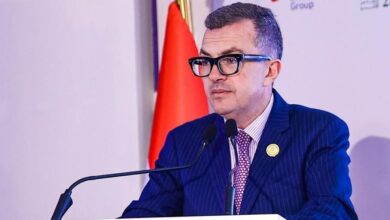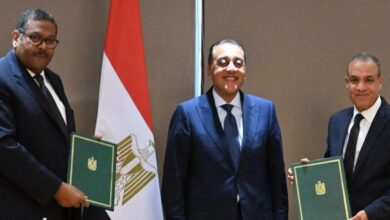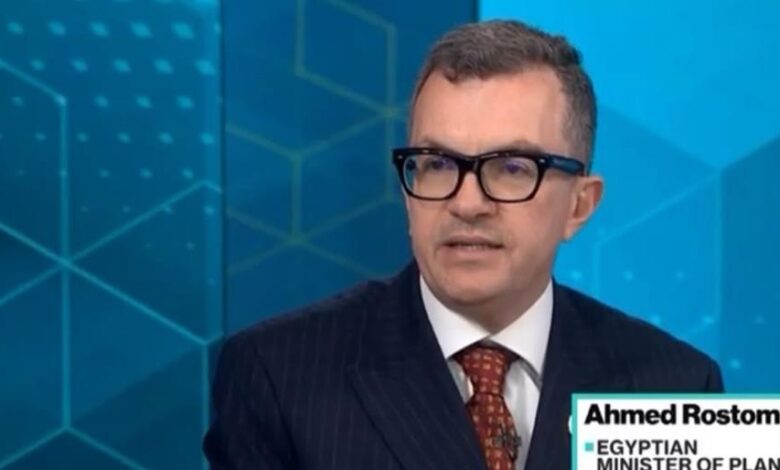
Minister of Planning and Economic Development Ahmed Rostom affirmed on Friday, November 27, 2026, that the Egyptian government is focusing on maximizing the resilience of the Egyptian economy amid global geopolitical conflicts and crises by proactively identifying and addressing potential risks.
This came during a television interview with Bloomberg anchor Francine Lacqua in London, following his participation in the eighth edition of the Ambition Africa forum.
Rostom added that Egypt achieved a growth rate of 5.1 percent at the end of the last fiscal year—among the highest recorded across the region and the African continent—in addition to recording a 4.9 percent growth rate during the first quarter of the current fiscal year.
Regarding the economic pressures resulting from the Iranian war, he explained that the energy crisis represents the primary source of pressure and one of the main drivers of uncertainty, not only for the Egyptian economy but for the entire global economy.
He noted the importance of adopting smart policies to address these challenges while identifying and capitalizing on available opportunities—an effort Egypt is actively pursuing by leveraging the diverse structure of its economy, which encompasses a broad mix of energy, productive activities and services sectors.
Turning to foreign direct investment (FDI), Rostom pointed out that Egypt recorded $18 billion in FDI during the last fiscal year, noting aspirations to maintain this positive trajectory and reach around $22 billion or more in the upcoming fiscal year.
The Planning Minister highlighted the sectors in which the government seeks to expand private sector participation, including tourism, information and communications technology (ICT) and logistics.
Addressing the private sector’s role in the economic transformation program, Rostom explained that the government is currently preparing the program, noting that private sector investments currently represent about 60 percent of total investments, with a target to raise this share to 67 percent over the next four years.
He explained that the private sector can play a larger role in the ICT sector—which represents one of the sectors of the future economy—alongside expanding its contribution to tourism and the services sector in general, as well as agriculture.
He affirmed that substantial opportunities exist for the private sector in manufacturing industries, particularly as Egypt seeks to deepen its industrial base.
Rostom stressed the need to view Egypt as an investment market that has proven its worth and resilience in facing various challenges, adding that investors can expect further facilitation and simplification of licensing procedures, alongside additional executive steps to implement the State Ownership Policy.
This will open further opportunities for private sector participation in the aforementioned sectors, including areas where the private sector already maintains a strong presence, particularly ICT, logistics and energy.
He added that Egypt is open to receiving investments across all sectors, foremost among them tourism, noting that tourism revenues reached around $18 billion during the last fiscal year and expressing expectations of attracting further investments in the field.
He also welcomed additional investments in logistics, given the pivotal importance of the Suez Canal as a main artery for global trade.
Regarding the Suez Canal and the outlook for its revenue recovery, Rostom explained that a rebound in the Suez Canal translates into broader economic recovery, as it provides a more efficient and faster corridor for trade movement and cargo transport.
He added that the canal accounts for about 25 percent of global container trade and 10 percent of global cargo trade, noting that Suez Canal revenues currently stand at around four billion, while witnessing increased transits of tonnages, vessels, and container ships, with expectations for continued recovery and a return of revenues to levels ranging between eight billion and nine billion annually or more.