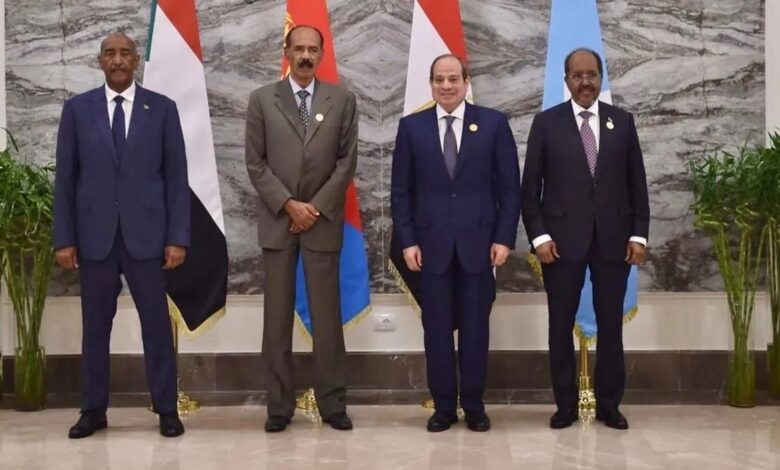
Egypt, Sudan, Eritrea, and Somalia at the El Alamein Joint Declaration held intense consultations regarding current regional and international issues.
The declaration followed a quadrilateral summit held on Sunday at the invitation of the Egyptian President Abdel Fattah al‑Sisi, Eritrea President Isaias Afwerki, President of Somalia Hassan Sheikh Mohamud, and Chairman of the Transitional Sovereignty Council of Sudan General Abdel Fattah al‑Burhan.
They also discussed ways to strengthen political, trade, and economic cooperation among the four nations and enhance their mutual consultation and coordination.
The summit addressed a number of issues, with consensus reached on the following:
- Supporting the unity, sovereignty, territorial integrity, and national institutions of the Republic of Sudan; rejecting the establishment of any parallel entities; encouraging the resumption of a Sudanese-owned and Sudanese-led political process; supporting national institutions; and categorically rejecting any support for mercenaries.
- Supporting the unity and sovereignty of the Federal Republic of Somalia; rejecting any interference or actions targeting its territorial integrity and national sovereignty; and rejecting any recognition of or support for the so-called “Somaliland,” as this constitutes an infringement upon the sovereignty and territorial integrity of the Federal Republic of Somalia.
- Supporting the Federal Republic of Somalia’s counter-terrorism efforts and the empowerment of state institutions to extend their control over the entire territory; and calling upon regional and international partners to provide adequate, sustainable, and predictable funding for the African Union Support and Stabilization Mission in Somalia to support the security transition process and enable the mission to execute its mandate regarding the orderly transfer of security responsibilities to Somali forces.
- Affirming the principle of freedom of navigation and that the governance of the Red Sea is the exclusive responsibility of the littoral states.
- Emphasizing the importance of respecting international law regarding transboundary rivers—including the Nile River—particularly following the principle of “no harm” and the obligation to cooperate through prior notification, consultation, and consensus; and categorically rejecting any unilateral measures that harm the existing water uses of the two downstream Nile states.
- Continuing to further strengthen consultation and coordination among the four countries and other sisterly African nations.
- Establishing a mechanism to follow-up on the outcomes of this consultative summit, which will be held periodically, and whenever the need arises, to enhance consultation and coordination among them.