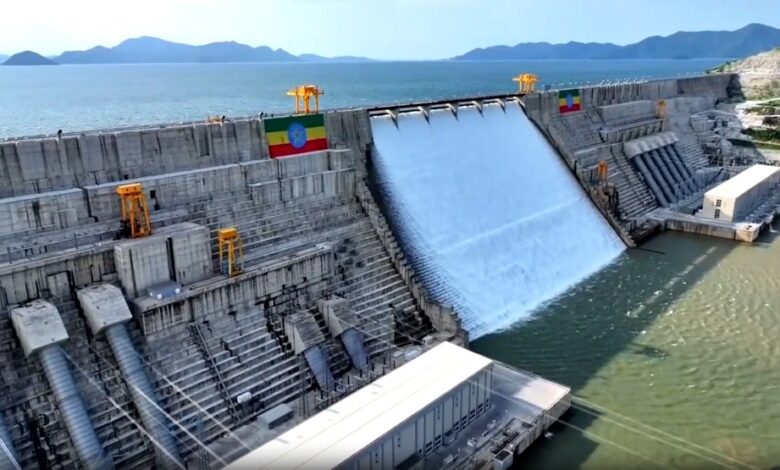
The Ethiopian Minister of Water’s recent statements regarding his country’s desire to build new dams have sparked controversy, amidst ongoing disputes between Egypt and Ethiopia over the Grand Ethiopian Renaissance Dam (GERD) and the lack of a legally binding agreement on its operation and management.
Professor of Geology and Water Resources at Cairo University, Abbas Sharaki, described Ethiopia’s statements as “provocative”.
He noted that the GERD issue remains unresolved and that discussions about constructing new dams on shared rivers will only exacerbate tensions.
Sharaki said that Egypt’s position on development in Ethiopia is “clear and explicit,” affirming that Egypt does not oppose Ethiopia’s right to development, the establishment of projects, or the utilization of its resources, for as long as these projects do not infringe upon the rights of other countries – particularly concerning the waters of the Nile River.
He added, “Ethiopia has the right to development, and Egypt has the right to life,” stressing that any projects on international and shared rivers must be undertaken through consultation and coordination among the concerned countries, leading to a legally binding agreement for all parties.
Water Rights
The professor of water resources explained that Egypt has affirmed over the years that it is not against development in Ethiopia, but will reject any infringement upon its water rights.
Egypt itself has implemented water projects outside its borders, including the Julius Nyerere Dam project in Tanzania, he noted, without causing harm to neighboring countries.
Sharaki continued that there is a difference between constructing internal dams on rivers not shared by other countries and constructing projects on international and shared rivers.
International River
He emphasized that the Nile is an international river, and any project built on its course or shared tributaries must adhere to international rules, laws, and agreements governing water relations among the basin countries.
Sharaki pointed out that Ethiopia has several rivers that contribute to the formation of the Nile, particularly the Blue Nile on which the GERD is built.
Therefore, any new projects on shared rivers must be subject to coordination and agreement among the concerned countries.
He emphasized that Egypt’s message is one of support for Ethiopian development, but “no to imposing a fait accompli on the Nile River, especially concerning the water rights of Egypt and Sudan.”
The professor of geology and water resources concluded by stressing that Egypt is committed to its water rights and that dealing with the issue of shared rivers must be based on cooperation and agreement, not on unilateral decisions or imposing a fait accompli.
Edited translation from Al-Masry Al-Youm